Monday, September 24, 2012

Wolfl String Quartets Op.3 and Op.10 - Quatuor Mosaiques

Wolfl Joseph (1773-1812) / Joseph Woelfl
Performer: Quatuor Mosaiques
Label: Paladino
Released: August 2012

Buy Here At Amazon
Buy Here at Classics Online

Joseph Wolfl, the Salzburg who popular for piano duel with Beethoven. He studied under Leopold Mozart and friend to Michael Haydn. Composed around eighteen string quartets, Op.4, Op.10 were in dated 1798-1799. And Op.30, which is believe as his youth string quartet. Op.4 is known as Trois Quartet, is a quartet concertants.

Three recording of his string quartets are now available, and the latest is Quatuor Mosaiques with his Op.4 and Op.10 recording. The previous are by the Authentic String Quartet Op.3, the Pratum Orchestra with Op.30. Quatuor Mosaiques that the left behind Op.10.
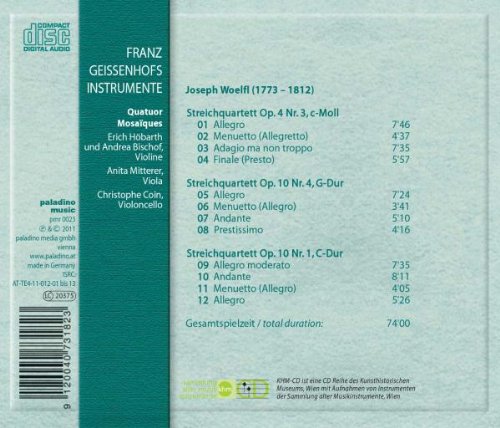
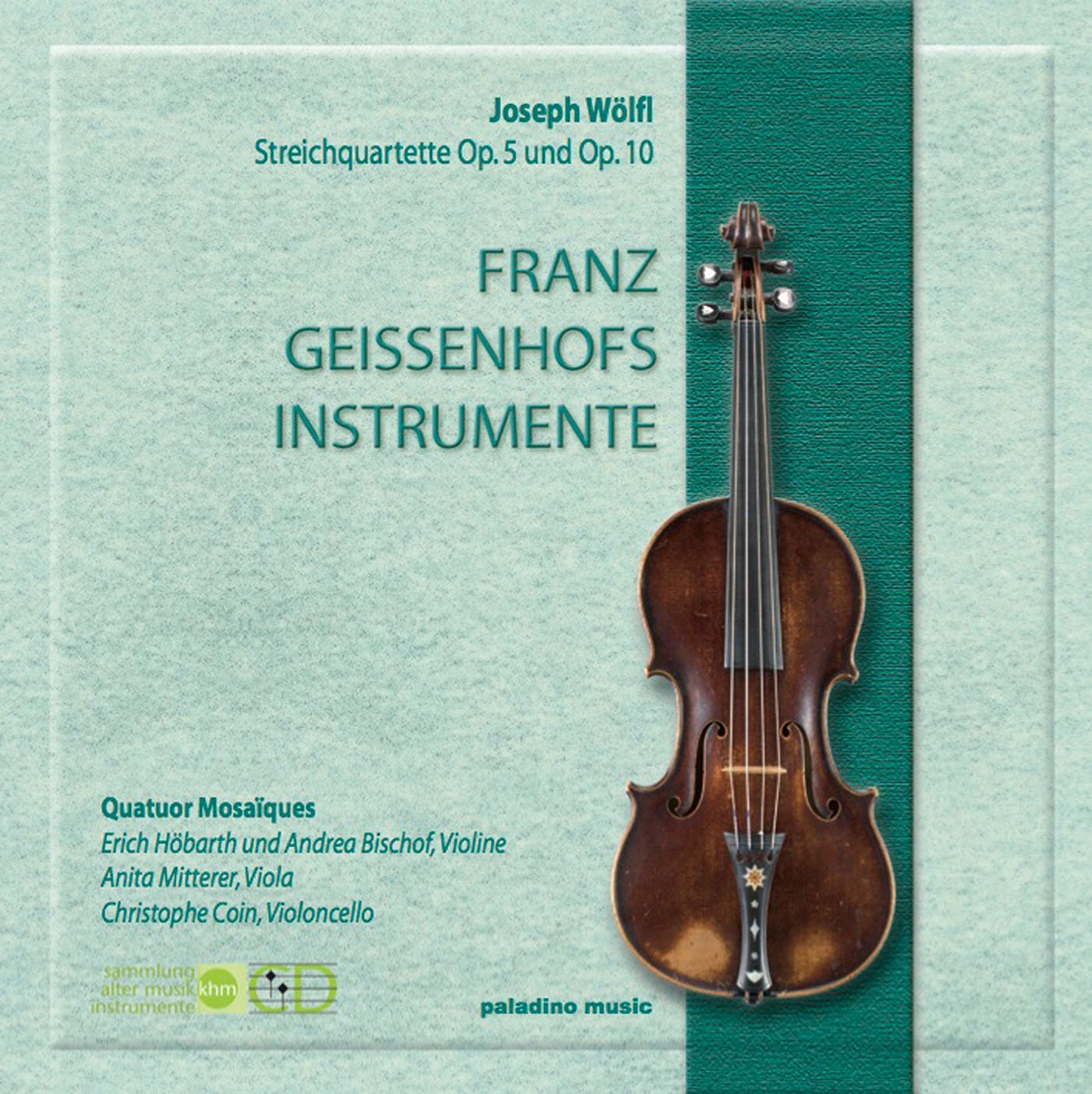

(missed print as Op.5)


Monday, September 17, 2012

A Late Quartet - A String Quartet Movie

Movie about string quartet is on the way. Directed  by Yaron Zilberman the movie called "A Late Quartet".

Members of a world-renowned string quartet struggle to stay together in the face of death, competing egos and insuppressible lust.

The Strad Magazines words : The musical centrepiece of the film is Beethoven's Quartet in C minor op.131, which the group is seen rehearsing for what might be its last performance together. The Brentano Quartet provided the soundtrack for these scenes, and according to an interview with Zilberman posted on wearemoviegeeks.com, the cast had to learn about 30 phrases each to make the playing look realistic in front of the camera.

Zilberman added that he modelled his quartet on several ensembles: the Guarneri Quartet, the Quartetto Italiano and the Emerson Quartet. Is the liner for the film. Starring:

Philip Seymour Hoffman ... Robert
Christopher Walken ... Peter Mitchell
Catherine Keener ... Juliette Gelbart
Imogen Poots ... Alexandra Gelbart
Wallace Shawn ... Gideon Rosen
Mark Ivanir ... Daniel Lerner
Liraz Charhi Megan McQuillan ... Brenda
Madhur Jaffrey ... Dr. Nadir
Anne Sofie von Otter ... Miriam
Marty Krzywonos ... Cab Driver
Rebeca Tomas ... Flamenco dancer
Jasmine Hope Bloch ... Cello Student
Sanjiv Hayre ... Audience Member
Cristian Puig ... Flamenco singer

Official website: http://tiff.net/filmsandschedules/tiff/2012/latequartet
IMDB http://www.imdb.com/title/tt1226240/

See trailer:


Tuesday, September 11, 2012

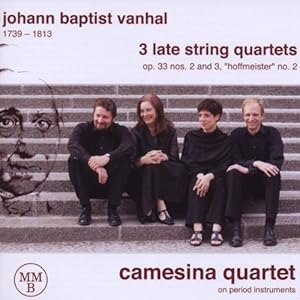
Vanhal - Late String Quartets (Camesina String Quartet)

Johann Baptist Vanhal
Performer: Camesina String Quartet
Label: MMB
Released: October 2012

Buy Here at AMAZON
Buy Here at Classics Online

Johann Baptist Vanhal (May 12, 1739–August 20, 1813) or Wanhal, an important Classical era composer with more than a hundred reported string quartet written, 70+ symphonies. He was into string quartet side by side with the giant Haydn and Mozart since he was regularly jamming together in all stars Haydn-Mozart-Dittersdorf-Vanhal string quartet. The string quartet only got attention of publisher and recorded very few. One is by Kubin String Quartet and now Camesina String Quartet effort to get the world know his Late String Quartet.

Camesina String Quartet was form in 2007, interesting note to the name is :
The name Camesina Quartet refers to the Camesina House where W. A. Mozart resided from 1784 until 1787 and where he played the six string quartets dedicated to Joseph Haydn for the first time in the presence of his elder friend. It was in this apartment where the famous quartet parties took place with Joseph Haydn (first violin), Carl Ditters von Dittersdorf (second violin), Wolfgang Amadeus Mozart (viola) and Jan Vanhal (violoncello) playing string quartets together. The house is named after the stucco plasterer Alberto Camesina, who owned the house for a time, and who decorated it with a Baroque stucco ceiling. It was under this ceiling that Mozart probably composed some of his greatest music, including the six string quartets dedicated to Joseph Haydn. Official site

The also recorded Dussek string quartet and probably going to be Classical Era specialized, and I warmly welcome the group so that more repertoire from the Era will survive. They are Germany based and played on period instruments.

See List of Vanhal's String Quartets

String Quartet op. 33 No 2 in A
String Quartet op. 33 No. 3 in F
String Quartet in E flat No. 2 "Hoffmeister-Quartet"


Saturday, April 21, 2012

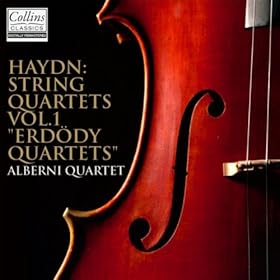
Haydn Erdody Quartet - Alberni String Quartet 2012

Joseph Haydn
Performer: Alberni String Quartet
Label: Collins Classic
Released: April 2012

Haydn Op.76 "Erdody" Quartets:
CD 1
Quartet No. 60 in G major, Op.76-1, FHE No. 40, Hoboken No. III:75
Quartet No. 61 in D minor "Fifths" Op.76-2, FHE No. 41, Hoboken No. III:76
Quartet No. 62 in C major "Emperor" Op.76-3, FHE No. 42, Hoboken No. III:77

CD 2
Quartet No. 63 in B♭ major "Sunrise" Op.76-4, FHE No. 49, Hoboken No. III:78
Quartet No. 64 in D major "Largo" Op. 76-5, FHE No. 50, Hoboken No. III:79
Quartet No. 65 in E♭ major Op.76-6, FHE No. 51, Hoboken No. III:80

buy it here at Amazon
buy it here at Classics Online

Collector of Haydn String Quartet need to pay one more addition to their shelf. Alberni String Quartet, a veteran ensemble hailed from Essex, UK decided to put in their signature of the Erdody String Quartet. The package is in two CD. Here comes the most famous Haydn set of quartet Op.76 included the Emperor quartet and the Fifth.

(it seems as 2015, Amazon no longer stock this CD...)


Dvorak String Quartet Op.106 - Cecilia String Quartet

Antonin Dvorak
Performer: Cecilia String Quartet
Label: Analekta
Release: March 2012

String Quartet No.13 in G  Op.106
6 Cypresses
2 Waltzes

buy it here at Amazon
buy it here at Classics Online

Cecilia String Quartet, the winner of 2010 Banff International String Quartet Competition (BISQC) debut their CD with Dvorak Op.106. This quartet based in Canada provided another point of view on Dvorak's second most important quartet, after his American quartet. Cecilia String Quartet choice is purely agreeable since their playing seems enthusias and playful, the happiness and melancholy parts are distinguish. One should forget the all female interpretation here and enjoy the universal work they done. A rich addition to the repertoire that decades away from the benchmark Prague String Quartet recording. The CD coupling also put in six Cypresses and Waltzes a genre which Dvorak put in the best for the string quartet.

Info on Cecilia String Quartet
the Toronto Music review


Boccherini Op.8 Six String Quartets

Luigi Boccherini
Performer: Quartetto D'Archi Di Venezia (Venezia String Quartet)
Label: Dynamic
Released: April 2012

Buy here at Amazon

Here comes another fresh recording of Boccherini most important opus of string quartet, the Opus 8. There were several recording of this Opus, notably by the Artaria String Quartet. But here the quartet recorded by the  homeland Venesia String Quartet. We welcome the rise of Boccherini works and hopefully more his other works get recorded in very soon.

Boccherini Opus 8 :
G 165: String Quartet Op. 8 No. 1 in D major (c. 1768)
G 166: String Quartet Op. 8 No. 2 in C minor
G 167: String Quartet Op. 8 No. 3 in E flat major
G 168: String Quartet Op. 8 No. 4 in G minor
G 169: String Quartet Op. 8 No. 5 in F major
G 170: String Quartet Op. 8 No. 6 in A major


Hamilton Harty String Quartet

Hamilton Harty
performer: Goldner String Quartet
Label: Hyperion
Released: May 2012

buy now at Amazon

In a rise of Britain chamber music by Maggini String Quartet, here comes another an Irish composer, Hamilton Harty (1879-1941). In this CD is a Piano Quintet in F and two String Quartets in F and Am. These two string quartets are a calm work and rich in melody. I think the style quite distint to his countrymen who most base their work on Anglo-Celtic scale. Harty's sound more universal, something more remind me of the Russian movement in this era.

A quote from the CD liner:

The first movement of the F major Quartet, full of invention and artifice, reveals if anything an over-ambition for developmental treatment in its zeal to explore new keys and new transformations. Yet one can detect a savoir faire in the handling of the quartet apparatus, and the melodic material is resourceful, bright and invigorating in its joie de vivre and contrapuntal dexterity. The will-o’-the-wisp scherzo in D minor, surely inspired by his knowledge of the late quartets of Beethoven and Mendelssohn, shows real flair in its quick-silver scoring and its love of tonal surprise, especially in the trio. The pastoral slow movement in B flat major is more expansive melodically and is richly scored. It also incorporates another surprise—the unexpected interpolation of the scherzo at its centre. The vivacious and technically demanding finale, which possesses musical ideas of lyrical interest and contrapuntal ingenuity, is an engaging if eccentric structure. Harty’s developmental phase begins in a remarkably chromatic manner (curiously suggestive of Bruckner) which leads with some surprise to a false yet extended recapitulation of the opening thematic material in E flat major. Even more unexpected, however, is the introduction of an entirely new episode before F major is restored for the final reprise, which has, by now, taken on the rhetorical mantle of a ‘rondo’ theme.


Harty’s String Quartet No 2 in A minor, Op 5, was composed after he moved to London in March 1901. There he rapidly became the capital’s leading accompanist and was in considerable demand by the most prominent soloists of the day, among them Fritz Kreisler, Harry Plunket Greene and Agnes Nicholls (whom he married in 1904). Like the first Quartet, the second was a prizewinner, this time for the Dublin Feis of 1902 where it was successfully premiered on 8 May. Harty was in the audience to hear it played by his friends from the Royal Irish Academy of Music, Arthur Darley, P J Griffith, Octave Grisard and Henri Bast. Its second and last hearing (prior to the present recording) was given by four prominent London musicians, Alfred Gibson, Juliet Capron, Alfred Hobday and Helen Trust, on 22 December 1902 at Copped Hall, Totteridge, Hertfordshire, the home of Sir Harold Edwin Boulton, an amateur poet and music-lover.

Revealing a marked advance on the first Quartet, this work, featuring a prominent ‘autobiographical’ viola part, is at once more fluent. The first movement evinces a greater sense of technical mastery of the quartet idiom, a feature, in fact, common to all four movements. The lilting ‘hop jig’ scherzo in 9/8, fertile in its dexterous manipulation of the hemiola, acts as a more vivid contrast with its trio in 2/4, while the slow movement imparts a more convincing sense of balance than its earlier counterpart in the first Quartet, as well as an intensely lyrical and more personal emotionalism at the climax. The imaginative finale, full of rhythmical élan, exhibits perhaps the most intricate writing for the quartet in the whole work, and the more embellished use of the slow movement’s second subject as secondary material is an effective cyclic touch. The appearance of this material in the unexpected and unconventional area of the subdominant reflects Esposito’s influence, but the most unusual introduction of new material—a chorale-like theme in F sharp minor—in the development and the much-truncated recapitulation reveal an entirely maverick streak of Harty’s personality which had been anticipated in the corresponding movement of the F major Quartet.